Skip to thread
TwitterShots
1 / 8
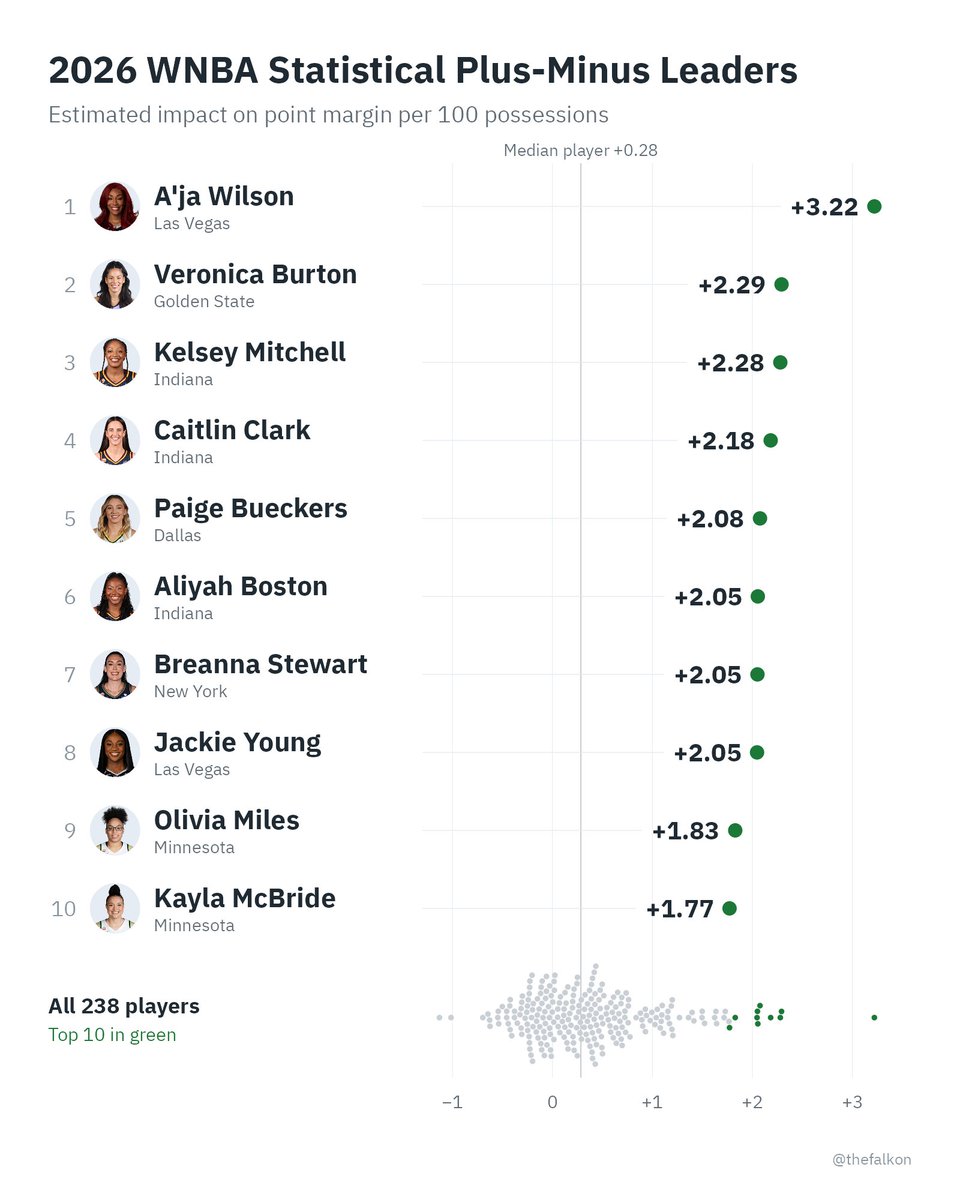
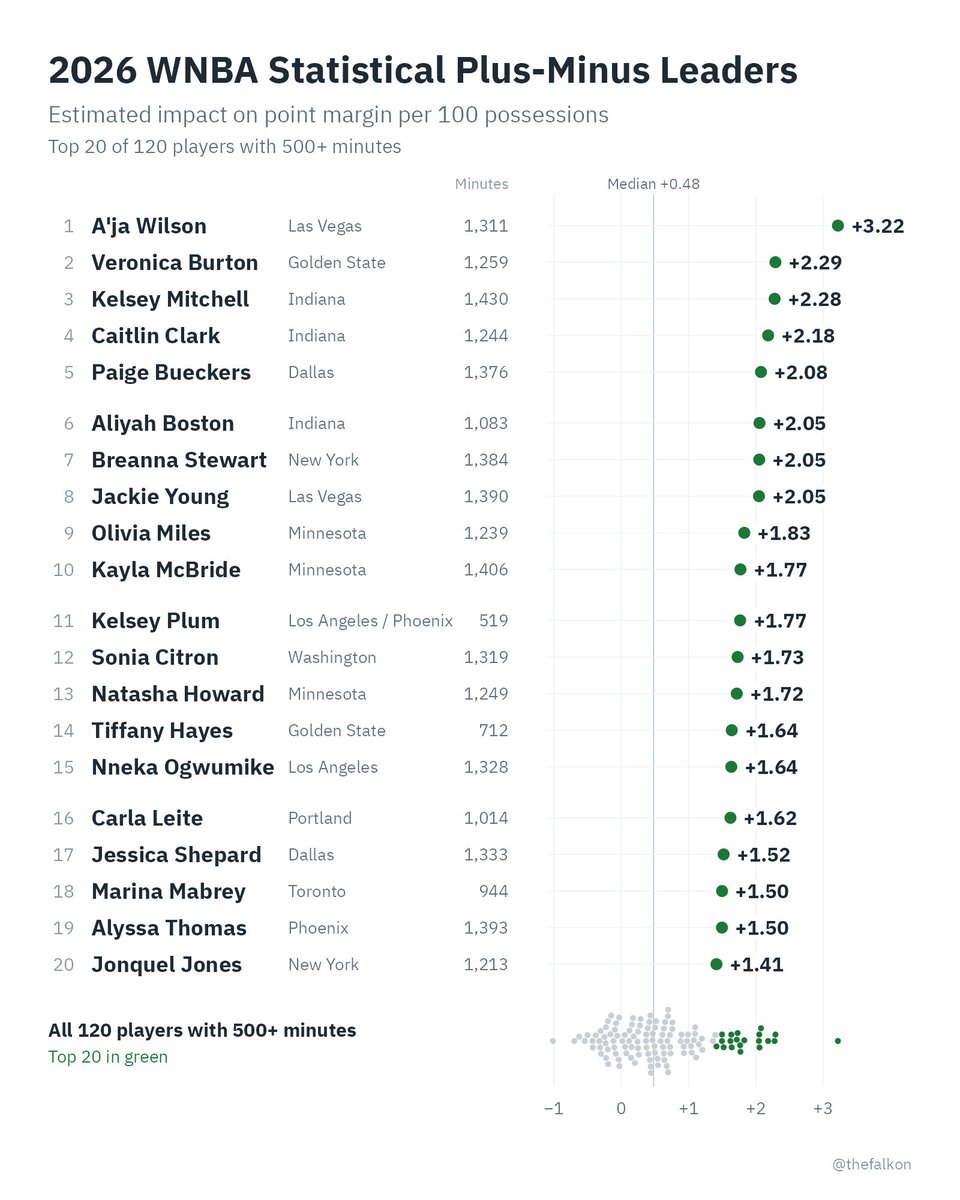
What's the value of a WNBA player's individual production? Enter Statistical Plus-Minus. It estimates impact by weighing different contributions from a player's stat line. SPM is more stable than RAPM, and it often produces more sensible rankings. Ranks + methodology below 👇
Tweet image 1
2 / 8
Excuse a brief aside on the target variable: SPM uses individual statistics to predict some measure of player impact. Traditionally, that measure is multi-year RAPM, since it's divorced from counting stats and it provides a relatively more stable estimate of lineup-based impact. For this SPM model, though, I used prior-informed, 1-Year RAPM as the target variable. The prior is the player's RAPM from the previous three seasons. Why? My goal was to build a descriptive single-season SPM model. Prior-informed RAPM is more stable and predictive than ordinary 1YR RAPM. It's also centered on the same season as the inputs (one season's worth of box score stats). Compared with multi-year RAPM, prior-informed 1YR RAPM accepts more noise in exchange for staying closer to what happened in that specific season. For a predictive SPM, I'd likely use a longer-horizon or time-decayed RAPM target. More info on my approach to prior-informed RAPM here: x.com/thefalkon/stat…
Dan FalkenheimDan Falkenheim@thefalkon
One-year WNBA RAPM is noisy. Can encoding prior information, without using box score inputs, help? Yes. Prior-Informed RAPM closes about half of the predictive gap with three-year RAPM, while estimates stay rooted in current season play. Ranks and details below 👇
3 / 8
The model’s inputs are one season’s worth of 14 individual statistics, all of which are shown below. Each of the features are: - Converted to a per 100 rate - Padded toward the league average - Measured relative to a season's specific league rate (this helps with era shifts)
Tweet image 1
4 / 8
A Generalized Additive Model performed best in validation. Linear regression worked well, too, and might be the simpler choice here. I constrained each GAM term to be monotonic to help avoid oddly shaped relationships that didn't seem to have a plausible basketball explanation.
Tweet image 1
5 / 8
More results: The validation-selected model had a validation R2 of 0.43 and a test R2 of 0.44 SPM also achieved an adjacent season mean Spearman correlation of 0.68, higher than both prior-informed RAPM* (0.58) and ordinary 1YR RAPM (0.34) *Prior-Informed RAPM isn't a 1:1 comparison with SPM or ordinary RAPM for stability. Since the prior shares some information in adjacent seasons, it's stability is inflated.
Tweet image 1
6 / 8
As Dan Rosenbaum noted in 2004 when he introduced SPM, the SPM ratings tend to be "cleaner" than RAPM. Face validation was encouraging, too. At least seven of the top 10 players should be All-WNBA selections. It wasn't perfect, though. See limitations below for more on that.
Tweet image 1
7 / 8
There are several limitations to the SPM model, as I have built it. - Prior-Informed RAPM is a noisy, heavily regularized target that leaves signal on the table. Any biases in RAPM carry through to SPM. - It was designed to be descriptive of how impactful a player's production was, not predictive of the impact of their production moving forward. - Individual defensive contributions are underexplored. There are more than two times as many offensive features as there are defensive features. SPM captures defense only to the extent it shows up in those box-score stats, so defenders whose impact doesn't manifest through steals, blocks, defensive rebounds or limited fouls will be underrated. (Quick example: a guard who suppresses their opponent's field goal percentage with strong on-ball defense.) Even deflections may be helpful, but the data isn't publicly available. With all of that in mind, I would consider SPM an offense-leaning estimate of player impact. - Even with padding, stats in a 44-game season can fluctuate and aren't always "stable" - The scale of the SPM ratings aren't comparable to NBA metrics. I find that my WNBA RAPM coefficients are more compressed than what I see elsewhere (maybe because of regularization strength, pooling low-minutes players and not splitting into ORAPM and DRAPM).

Publish your own threads

Turn any X thread into a clean, shareable page like this one.

Get started

Published on TwitterShots · Thread by @thefalkon

Content from X belongs to the original author.

Thread by @thefalkon (8 tweets): What's the value of a WNBA player's individual production? ... | TwitterShots